
Will climate change benefit some regions?
Some regions will experience moderating climate, leading to improved recreational and agricultural conditions, as well as relatively lower and smoother insurance cost curves.
What's the investing angle:
Moderating climate combined with attractive lifestyle and geographic restrictions will drive outsize growth.
Beach towns in the Pacific Northwest.
Ski towns at higher latitudes.
Corporate HQ’s will relocate to areas with low likelihood of disruptions to business continuity. For example:
Power outages can persist for weeks.
Employees may have to move or lose access to schools, disrupting their ability to focus and contribute at work.
The key is finding dynamic economies with good governance that will drive dependable returns in real estate.
Article:
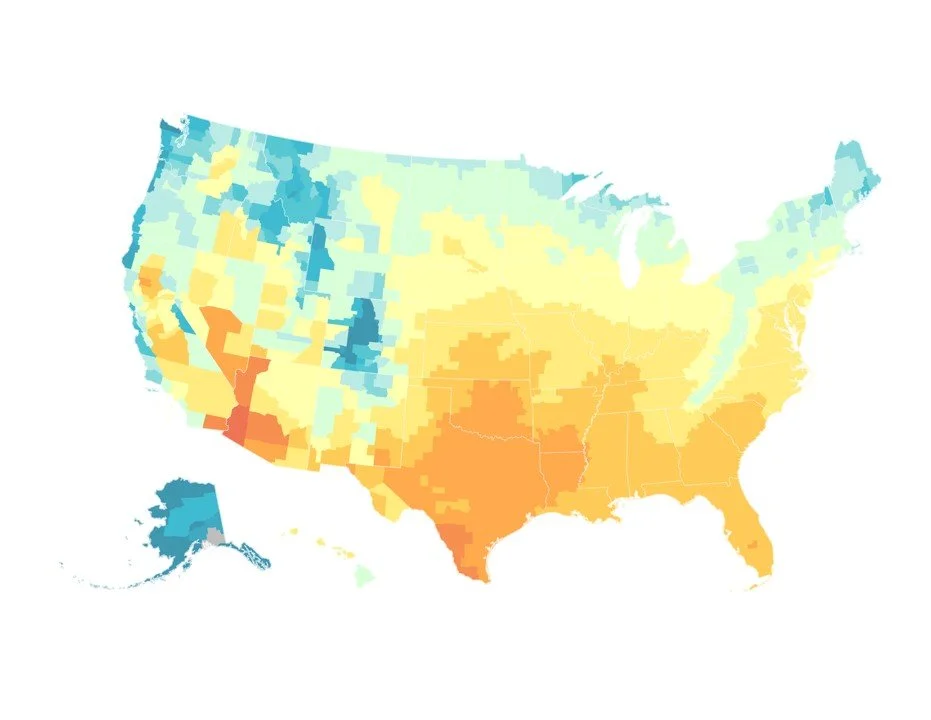
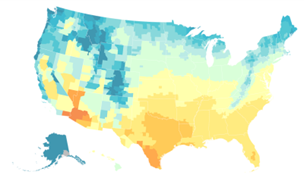
Exhibit: Average June/July/August temperatures - the left image is historic data for 1986-2005; the right image is projected data for 2040-2059 under medium-high emissions (SSP3-7.0) scenario. Images from University of Chicago's Impact Lab
Warmer average temperature. More sunny days. This is what we expect for the Pacific Northwest.
Over the long term, we expect increased migration from impacted areas as well as people simply attracted to the more pleasant weather.
Migration will also be driven by fiscal risk. We may know how to engineer the solution (flood control, fire fuel management), but the fiscal support may not be adequate, especially in a tax-averse nation like the United States. Instead, policy makers choose strategic retreat.
Aon, the insurance and risk consultant, expects more businesses using location analytics and job assessments to redeploy resources and ensure employee safety. Leaders must proactively boost workforce resilience amid natural catastrophe and climate challenges.
There will still be risk
While the Pacific Northwest may benefit from warmer temperatures and more sunny days, the same projections show increased wildfire risk and increased sea levels.
One big question is: over what time line? Climate may moderate in the near term, then become more severe over the long term. How to think about this. (Link to insight about tipping points and tail risk)
How University of Chicago’s Impact Lab generates projections:
“The Climate Projections available here are derived from the Climate Impact Lab’s Global Downscaled Projections for Climate Impacts Research (GDPCIR), freely available on the Microsoft Planetary Computer (Gergel et al, 2024).The GDPCIR dataset makes use of statistical bias correction and downscaling algorithms, which are specifically designed to accurately represent changes in the extremes. Specifically, the Quantile Delta Mapping (QDM) approach was selected, following the method introduced by Cannon et al. (2015), which preserves quantile-specific trends from global climate models while fitting the full historical distribution for a given day-of-year to a reference dataset (ERA5). To produce GDPCIR, an additional method is introduced, tailored to increase spatial resolution while preserving extreme behavior, Quantile-Preserving Localized-Analog Downscaling (QPLAD). Together, these methods provide a robust means to handle both the central and tail behavior seen in climate model output, while aligning the full historical distribution to a state-of-the-art reanalysis dataset and providing the spatial granularity needed to study surface impacts.”
Further information is available on Impact Lab’s website.
Insights
-
Related Insight #1
Description - Related Insight #1
-
Related Insight #2
Description - Related Insight #2
-
Related Insight #3
Description - Related Insight #3